The fremony at the library

This news item first appeared in the Peterborough Standard in 1979. Someone sent the clipping to Private Eye, which is where I read it and promptly came close to death from oxygen starvation.

It was and remains one of the funniest things I have ever read, although I recognise that it’s not to everyone’s taste.

Fremony at the library

Apologies for the quality. It’s been in my cuttings file for more than 30 years.

26 Comments

Filed under Stuff

Stumbling over copy

I’m showing my copy to the account director. I watch closely as she reads the text. I like to think that I can tell exactly whereabouts she is on the page simply by observing her reactions.

That little nod means she’s reached the part in the opening paragraph that resolves the slight sense of intrigue contained within the headline. Smaller, almost imperceptible nods mean she’s mentally ticking off the product’s key selling points. And that half smile must be in recognition of the little gag I put towards the end, which neatly refers back to the headline. I begin to smile myself.

But what’s this? She doesn’t hand the copy back. Instead, she narrows her eyes and picks it up off the desk. She holds the sheet of A4 a few inches further away from her, as if she’s suddenly having trouble focusing on the words. She frowns and her lips start forming an O.

“All OK?” I say brightly, conveying, I hope, an air of finality.

“Yes,” she replies. I’m just having trouble with this word.” She mentions the word.

“Really? I quite like that word. I thought it made a nice change from the usual.”

“Maybe that’s it. It wasn’t what I was expecting. I stumbled over it.”

There it is. The stumble word. We can’t have people stumbling. In copy, everything’s got to be smooth and level and free of any linguistic obstacles. Gently undulating is acceptable, but molehills, potholes, sudden twists or turns; these are verboten.

The nice flat plains in the south of Australia's Northern Territories are interrupted by this unsightly stumbling block, Uluru.

Were you expecting ‘forbidden’, there? That’s what I had in mind, then I changed it to verboten at the last minute. It sounded stronger, more absolute. But did you…stumble? Did you stare at the word with a look of bafflement, shake your head and go back to Twitter?

I think copywriting that sometimes uses the unexpected or the unfamiliar – even, in the right circumstances, the unheard of – can enhance the experience of reading it.

That’s doesn’t mean being wilfully obscure or peppering your copy with impenetrable jargon. It just means occasionally straying from the everyday, the overly familiar and definitely the clichéd.

I thought about this the other day when I came across this poster for Fitness First, ostensibly encouraging people to join their gyms. Health clubs tend to pour most of their ad budgets into January for obvious reasons, though it would be interesting to see if this campaign makes a blind bit of difference to FF’s membership:


Try not to look at it for too long.

Now this poster isn’t in any way a shining example of the adman’s craft. I think that possibly every element of it could be improved. But the thing that stood out for me, as I casually took it in while padlocking my bike by the train station, were the words ‘our members are fitter than yesterday.’

Fitter than yesterday. I”ve never heard that expression. A search on Google (UK) yields just three examples, none of which uses the phrase as a figure of speech. So whoever approved the copy for this poster – and it must have gone through SOME sort of approval process – wasn’t unduly concerned about it containing a phrase that might have made people ‘stumble’.

I thought it sounded quite cool. It contained a truth. It required a teensy bit of thought. The words made me think, ever so briefly, about fitness, age, decay and mortality. Had I not heard the sound of my train approaching, and had the rest of the ad not been such a complete fucking disaster, I might have made a mental note to book an appointment at the nearest gym.

Sometimes, it’s good to stumble.

13 Comments

Filed under Ill-informed advertising observations

“Late again, Williams?”

The good thing about working in advertising – forget the long lunches, the exotic shoots, the opportunity to write eye-catching advertisements; these are all the stuff of urban legend – the really good thing is that most London agencies start work at 9.30am rather than the usual nine o’clock.

A 9.30 start is just late enough to miss the worst of the rush hour. It means that in theory you can enjoy a leisurely breakfast before setting off for work. In practice, it means you set the alarm to go off at the last possible moment and end up scoffing a Danish at your desk when you finally do arrive. But still.

I’ve worked full-time at three London agencies and have been lucky enough to haul myself in for a 9.30 start at all of them. The most recent was a place called DraftFCB.

It wasn’t always called DraftFCB. It used to be known as Draft, and before that it was called Draft London, and before that it was called Lowe Live, and before that it was called Lowe Direct. Today it’s known as FCBInferno.

But the agency I joined in 1997 was Lowe Direct.

Lovely place. Nice people. Good work. Linen hand-towels in the bathrooms. And a 9.30 start. How civilised.

Anyway, fast forward to 2007 and the latest name-change stroke re-branding stroke merger is announced. Draft is to merge with the famous old Madison Avenue agency FCB. (Foote Cone and Belding, or Foot Crushed and Bleeding, as no one called it.)

I can’t talk too much about the actual merger because there were, you know, issues. Headcount issues. We all had to sign something, and then most of us also had to leave and find other work. But before all that kicked off, we had one of those ‘this is going to be GREAT!’ pre-merger meetings.

There’d be an expanded client base.  Opportunities to deliver incisive strategic initiatives. Amalgamated and streamlined things. Shiny stuff, across the board. Shorter queues for coffee, because of the issues you won’t be allowed to talk about. And guess what! The agency we’re merging with start work half an hour later than we do!

Draftfcb’s spacious offices in Victoria. Note how spacious they were. All that space.

This was good news. This was almost unheard of. Everyone looked at each other with broad smiles and secret thoughts about how they’d spend their extra half-hour. 10.00am was very nearly lunchtime!

After the meeting we all headed back to our desks, or content creation modules as they were now known. There was general anxiety about the merger, tempered only by the welcome news of the later morning start.

“That extra half-hour’s going to make all the difference,” said someone. “Getting in at nine has always been a killer.” People nodded.

“Wait,” I said. “You’ve got it wrong. You’ll be starting half an hour later. Ten o’clock.” As soon as I said it out loud, doubts started to gather.

And sure enough, I was the one who’d got it wrong. The official start time of the agency I joined in 1998 was 9.00am. Apart from when I’d turned up early for pitches or for other genuine worky reasons, I’d been exactly half an hour late, every single day, for the previous 10 years. 

And the headline of this blog? That relates to an art director I used to work with, an amazing character called John Williams. Yep, he knows all the jokes.

He strolled into reception one morning at about 10.15am, bleary of eye and over of hung. Just as the lift doors were closing, the managing director jumped in and barked ‘Late again, Williams!’

Without missing a beat, he said ‘Yeah, so am I.’

2 Comments

Filed under Ill-informed advertising observations, Stuff

Changing the world – one cliché at a time

I’m like a red rag to a plague when it comes to clichés. I avoid them like a horse! But I can’t help noticing them, especially when they seem to be encircling me like moths in a china shop.

One cliché that’s attracted my attention recently has been a variation on doing something one step at a time.

We all do things one step at a time, of course.  It’s generally accepted to be the ideal method of walking, for example. But this is something else. It’s an idea, a hope, an audacious reach-for-the-stars belief that one person can change the entire world by doing something in tiny, incremental steps. Sometimes it’s more than one person. Sometimes it’s a group, a cult, a small coterie of like-minded people, and sometimes it’s a humungous multi-global congomerate. I’m looking at you, Nike.


Match the aim with the means-type competition

So now you get the general idea, it’s time to see if you can match a website’s grandiose aim with its proposed oh-so-gradual means of achieving that aim. For example, if you think the aim of Overclocking the World will be achieved One sausage at a time, say so to yourself or write it down or something.

Unlike other competitions, there’s no 2nd or 3rd prize or indeed any prizes at all. And in another break with competition orthodoxy, I’m not really interested in your answers. Have a go anyway. You never know, you could get all of them right!!!

Chasing greatness One conversation at a time
Overclocking the world One slap at a time
Photoshopping the world One assertion at a time
Conquering the world One mall at a time
Curing pneumonia One sausage at a time
Taking back the world One Syrah at a time
Preserving the past One contract at a time
Testing the world One PC at a time
Creating the future One banana at a time
Making America skinny One pixel at a time

Until next week then. Poodle tip!

5 Comments

Filed under Stuff

Allez Calais

Remember the infamous booze cruise? Every weekend the cross-channel ferries would carry thousands of Brits over to Calais where they’d frenziedly strip the local supermarkets of as much cut-price beer, wine, spirits and ciggies as they could cram into the boots and back seats of their Fords and Vauxhalls.


P&O's Pride of Dover heading towards Calais. Or possibly Dover.


It was an unedifying spectacle, from the shoppers’ refusal to explore a France beyond the shopping mall to the almost mandatory obligation some of them had to vomit the moment the vessel set sail. There were other certainties too, such as someone always pointing out that the white cliffs of Dover ‘arent really that white’, or that on a smooth crossing the Channel is ‘like a millpond’.

British retailers were quick to exploit the trade, with branches of Oddbins, Tesco and Majestic soon opening up in the northern French ports. Other, less well-known stores sprang up, although with names like Eastenders, Cheers and Boozers Wine & Beer Warehouse, they left you in no doubt as to who their target market was.

I used to do the booze cruise as well. Living in the south-east of England made it easy, and competition between the ferry companies and the channel tunnel made it pretty cheap, too. Usually there’d be four of us, my wife and another couple. The men would take it in turns to drive. Some undefined but well-established law exempted the ladies from driving. They’re clever like that.

Plain sailing

We gradually discovered the best way to do the journey, at least the seafaring part. For around £10 more per person, you could go P&O Club Class. Boy, is it worth it. Not only do you get complimentary champagne and coffee (plus biccies); not only do you have a great view of the sea and, in some vessels, a working radar that lets you see how close you are to a mid-channel shipping disaster; not only do you get comfortable seats and free newspapers. Crucially, you also get to avoid the noisy mayhem of the lower decks: the slot machines, the shouty kids, the curry and chips, the pints of lager.


First in the queue for le Full English.


Another useful refinement is Priority Boarding. This means you’re amongst the first to drive on to the ferry and so are amongst the first to drive off.  It’s another additional expense, but you weigh that against your hatred of queueing. What we tend to do is have the priority boarding thing on the outward journey but not Club Class. The reason? By being first on you can be sure of grabbing a table at the on-board Langan’s and can enjoy their mighty breakfast. By the time you’ve finished that you’re virtually docking anyway, so you’ve no need of Club Class.

On the way back it’s the other way round. Don’t bother with Priority Boarding but do make sure you’ve booked Club Class. You’ll appreciate the rest, the quiet, the bubbly etc and, if you’ve still got some money left after all that shopping, you’ll love the massage.

It’s not just about saving money. Luckily

When the credit crunch hit, day trips to France suddenly became a lot less justifiable for many people. The potential savings you could make on a case of wine or beer no longer seemed that great. Indeed, such was the reduction in booze cruise shoppers – ourselves included – that the Calais outpost of Tesco closed its doors in 2009. How often does a Tesco close?

But then a recent mailshot from Majestic made me reconsider: choose wisely and it’s still possible to make some pretty good savings.  You can get a decent Cotes du Rhone for around £3.45 while a bottle of  the delectable Montana Pinot Noir costs £5.99 in Calais – in the UK you would expect to pay £12 or more.

But for me and my friends, the shopping is only part of the day out. (With the ability to order in advance, it’s quite a small part. All you have to do is turn up, pay up and load up.) We see it also as a fantastic opportunity to take advantage of our proximity to another country. It’s a holiday, albeit a very brief one. So after the shopping we visit local towns or villages, in the summer we might go to the beach, we’ll check out a few bars and, of course, enjoy a humungous meal. French roads being far less congested than in the UK, it’s amazing how far you can get in a day.

Mind you, we always end up getting lost. Once we had literally no idea where we were when we happened upon a load of breakdown trucks parked at their base in an air de repose. We tracked the drivers down to a concrete hut. Seated around a table, they were all playing cards, smoking Gauloises and drinking brandy. This was about 10.30am. Don’t break down in France.


Checking our order


It's not all wine. Coffee works out cheaper too.


Bowlers and Disney braces are the latest rage in France amongst this one man.


The French really know how to give it some welly


Carol ignored my warnings about the superglue


The dome of the Basilica of Notre-Dame de Boulogne. Thanks, Wikipedia


Scary French Halloween window display


Ditto


Carol and Jackie doing their best 'and then what happened' looks


Geoff says a bar steward took this picture, but I think he was an alright guy


Club Class passengers get unlimited* complimentary biscuits. *Biscuit provision may be limited


With a look that says 'When will this hell ever end?', Bravenewmalden considers restricting the tip for this onboard massage to all the money he has.


Enjoy it while it lasts. An all-too-rare full wine rack


Leave a comment

Filed under Stuff

Having one less digit in a digital age

Along with date of birth, height and occupation, there used to be a space on the old-style British passport that noted the bearer’s ‘distinguishing marks’, or signes particuliers. Most people didn’t have distinguishing marks, or in any case not distinguishing enough for the UK Passport Agency.

I’m sure many applicants struggled to think of something that would have separated them from the herds of run-of-the-terminal, undistinguished passport holders. ‘Endearing smile’, ‘freckle configuration reminiscent of Ursa Major’ or even ‘mammoth tits’ might have been put forward. Not good enough. These peoples’ passports carried the crushing word ‘none’.

I, though, did have a distinguishing mark. On my passport it stated ‘TOP JOINT, FOURTH FINGER, R.HAND MISSING’. My pride in this was almost enough to counter the bouts of hilarity whenever anyone saw my passport photo. Like middle names, passport photos are guaranteed to provoke mirth regardless of how ordinary they are.

My phalange shortfall

See? There’s nothing remotely amusing about this, my first-ever passport photo

So how did it come about, this 33.33% deficiency in the pinky department? Well, I lost the top of my little finger in a car door accident.

This explanation normally makes people grimace briefly, before they recover and say “well, at least it was quick. Clean break and all that.” Then I go on to explain that it wasn’t the result of a car door being closed, but being opened. Their expression changes once more.

The car in question was a 1950’s Ford Prefect (registration FBD 528). This wasn’t part of some classic car restoration project. It was the family car. Yes, I really am that old. But at the time, I was very young. Just turned three, in fact. I had two older brothers who sat in the rear of the car, while I had to sit on my mum’s lap in the front. (No seatbelts to get in the way back then.)

A Ford Prefect, the inspiration behind the eponymously-named character from HHGTTG

We had stopped off at a shop on the way back from a day out to pick up some shopping. I waited on the pavement for my mum to get in first. I was leaning against the car with my hand splayed out against the central door pillar. Then one of my brothers opened the back door. My fingers were caught between the door and the pillar; as he opened the door it slowly sliced off the ends of two fingers.

I believe I may have uttered some expression of astonishment.

My father: lawbreaker

My memories of the actual incident are largely derived from others’ testimony, but I do have a strong recollection of my dad breaking the speed limit for perhaps the first time in his life to get me to A&E as quickly as possible.

The subsequent operation to reattach my fingers was only a partial success. The top of my third finger hadn’t been completely severed and was stitched back more or less as good as new.

The pinky fared less well. Perhaps the surgeon was a bit mean with the stitches. Whatever the reason, I had to revisit the hospital a fortnight later for the fingertip to be permanently removed.

People rarely notice its absence. I can be friends with someone for years before they suddenly stare open-mouthed at my hand. Or I’m in one of those my-scar-is-bigger-than-your-scar pub conversations, and I have to think of something to trump their Glasgow smile, AK-47 exit wound or Great White leg injury. That’s when I nonchalantly raise my little finger to looks of general incredulity.

Spot the difference

Curiously, the people most likely to notice are those who themselves are short of a digit or two. I have no idea why this should be. I certainly don’t go round looking at people’s hands to see if they have their full complement of fingers.

Some disadvantages of little fingerlessness

  • Not being a world-class drummer like Terry Bozzio. The thick end of the drumstick sits just where my stump is. (I think that might be a unique sentence.) So when I hit the drums hard, it starts to hurt. I know Rick Allen of Def Leppard managed to continue playing after the amputation of his entire left arm, but that’s different. He had the advantage of being talented.
  • In cold weather, my little finger starts to feel cold before the rest of me. In fact it gets bloody cold. My mum, bless her, once knitted me a pair of gloves with a foreshortened little finger. Awww.
  • If I used all ten fingers to touch-type it would potentially reduce my overall speed by as much as 10%. Luckily I only use two fingers, which itself is 100% more than I use to play the piano.

P.S. The picture above this one was taken with the Mac’s built-in camera, which produces a reverse image. Hence the little finger appearing to be on my left hand.

P.P.S. I reserve the right to blog about stuff that’s personal to me. I hope you enjoy reading it.

2 Comments

Filed under Anecdotage, Stuff

Reading made easy

Cider with Rosie, by Laurie Lee

Chapter One – First Light

  • I was set down from the carrier’s cart at the age of three; and there with a sense of bewilderment and terror my life in the village began.
  • The June Grass, amongst which I stood, was taller than I was, and I wept.
  • I had never been so close to grass before.
  • It towered above me and all around me, each blade tattooed with tiger-skins of sunlight.
  • It was a knife-edge, dark, and a wicked green, thick as a forest and alive with grasshoppers that chirped and chattered and leapt through the air like monkeys.

Did you have any trouble reading that opening paragraph from Cider With Rosie? You shouldn’t have. I made it easy for you by splitting the text into handy bullet points.

Laurie missed an obvious story-telling trick

Using bullet points in this way makes heavy blocks of text easier to read and digest. Without them, the dense forest of words looks intimidating. It creates a fear in the would-be reader that, were he to embark upon the ordeal of reading the text, he would only get as far as the fourth or fifth line before realising that he’d completely forgotten what was said in the first.

The utter refusal of authors to employ bullet points in this way shows complete contempt for their readers and probably explains why the vast majority of them remain unknown and unread. Can you imagine how much more popular the long-forgotten novel Peter Pan might have been if its author, one J M Barrie (?), had started the book like this:

  • All children, except one, grow up.
  • They soon know that they will grow up, and the way Wendy knew was this.
  • One day when she was two years old she was playing in a garden, and she plucked another flower and ran with it to her mother.
  • I suppose she must have looked rather delightful, for Mrs Darling put her hand to her heart and cried, ‘Oh, why can’t you remain like this for ever!’
  • This was all that passed between them on the subject, but henceforth Wendy knew that she must grow up.
  • You always know after you are two.
  • Two is the beginning of the end.

See? The very idea of that reasonably promising opening being expressed in a solid block of black type goes against every grain of common sense.

Have I made my point?

You can sense that I’m being sarcastic here. And if you know me at all you can probably tell that I have recently experienced some sort of conflict involving the enforced deployment of bullet points.

Yes, and yes.

I had written a booklet setting out the design and copy guidelines that designers, art directors and copywriters should adhere to when creating material for a new advertising campaign.

The logo should always appear bottom right. Headlines should always be in Helvetica. That sort of thing. (Obviously it went into a little more detail than that.)

I’d used a mixture of bullet-pointed copy where it was appropriate, and regular copy where it wasn’t. But the client decided that all the copy should appear in bullet point format. So all the sentences that were designed to flow together, forming a narrative that makes sense to the reader, were summarily disconnected and made to stand alone.

The result of this was:

  • The copy in some bullet points was quite long because it had originally been a longish sentence
  • But not in others
  • As each sentence was honoured with its own bullet point, readers were likely to infer that each ‘point’ was invested with equal importance
  • They clearly weren’t
  • Narrative copy doesn’t work like that
  • Then there’s this irony
  • Mixing long bullet points with short little staccato ones created on the page the sort of design chaos that the guidelines were in part trying to prevent
  • And you had bullet points beginning with But and However and And

You could argue with some justification that as the booklet was aimed at designers it should be completely idiot-proof. Designers, it is often thought, think excusively in visual terms and have at best a nodding acquaintance with the written word.

Help for designers. Image courtesy leaeva.com

Well, maybe so. There’s no shortage of appalling design to lend weight to that theory. But the worst offenders aren’t going to pay attention to any copy, whether it’s in paragraphs, bullet-points, tattooed on their foreheads using mirror writing or personally set in second-coming type before their very eyes by Neville Brody dressed in a tutu.

A tutu

Neville Brody

Bullet points are great for lists of things. Dos and don’ts,  for example. Or when you want to show a number of different sizes of things: figures look confusing and illegible when expressed in flowing text.

They work best when there’s between three and 10 bullets. As mentioned, they should all be about the same length. Put a full stop at the end of the last one or not at all. No one will mind. Make sure the leading letter of each word can’t be added together to spell TITFEST. You’d be surprised how often that happens.

Are there any opening paragraphs that could benefit from being given the bullet(s)? Well, that chap Dickens wrote some titanic sentences. Perhaps we could rework the opening sentence of:

A Tale Of Two Cities

The following book is set in the:
  • best of times
  • worst of times
  • age of wisdom
  • age of foolishness
  • epoch of belief
  • epoch of incredulity
  • and many more enticing dichotomies
As the story unfolds it will be seen that contrasts continue to take centre stage as the protagonists:
  • had everything before them
  • had nothing before them
  • were all going direct to Heaven
  • were all going direct the other way
In summary
The period was so far like the present period, that some of its noisiest authorities insisted on its being received, for good or for evil, in the superlative degree of comparison only.

Hmm. That still needs a bit of work…

8 Comments

Filed under Ill-informed advertising observations

A solution looking for a problem

“I can’t take it any more, Oliver. I’ve got to get out!”

“Get a grip, Camilla. We’ve put up with far worse. Last week it was set to 3 and we pulled out of that alright. Hang on in there, old girl.”

“But it’s relentless. It’s driving me insane. It’s alright for you, you’re not directly in its path like me.”

“Now that’s not fair, Camilla. It affects me just as much. If not more, as it’s pointing right at me when it changes direction. You suffer only when it passes in front of you.”

“You’re right I suppose. Now it’s got us fighting each other! Oh God, Simon. If it wasn’t for this accursed heat we could turn the blasted fan off!”

“Wouldn’t that be bliss, Camilla? Then we’d no longer have to endure this…unpleasant buffeting!

Yes, ‘unpleasant buffeting’ has apparently been the fundamental problem of traditional fans for more than 125 years. Who knew?

James Dyson, for one. Four years ago he briefed his ‘fluid dynamics engineers’ to set about designing a fan that would end the monstrous buffeting problem once and for all.

Dyson's new Air Multiplier (x 2)

The result was the Dyson Air Multiplier. Sorry, Air Multiplier™. It’s being advertised in all the colour supps right now and certainly looks different from your regular fan. There are no blades, you see? Well, there are, but they’re hidden in the base, where they force air up through the circumference of the device.

That accounts for some of the buffetless air you feel on your hot, flushed face. The rest is created using an impenetrable technology that involves “the inducement and entrainment of surrounding air.”

The fan looks a little like something you’d set light to before encouraging small dogs to leap through. As for the flowing air it produces, that feels quite nice. Can’t say the absence of unpleasant buffeting was something I noticed straight away. But there again its presence was not something I’d ever noticed before.

The need to turn a fan on was never accompanied by a corresponding sense of dread that the partial relief from hot, still air would be mitigated by my body being pummelled remorselessly by an unseen force. If unpleasant buffeting was the inevitable consequence of activating a fan, people in those countries where ceiling fans are commonplace must be congratulated on never having rioted or overthrown governments as a result of their bodies being battered morning, noon and night.

And yet this buffeting thing crops up in all Dyson’s adverts as being virtually the sole benefit of the product. They can’t say it keeps you cooler than traditional fans, because it doesn’t.

In fact, as with all fans, there’s a case to be made for them having the opposite effect. After all, electric fans generate both heat and friction. The relief they provide might well be illusory, like the idea that the consumption of alcohol warms you up on cold nights.

You might be better off with one of those hand-held Lady Bracknell-style fans, although again any relief you derive from the increase in airflow over your skin will probably be offset by the increase in sweat you build up by waving the thing.

'Would you mind getting your baby to stick her arm in that fan thing while I take a picture?' 'Certainly. That's not an unusual request at all.'

The Dyson fan scores  well in other areas. It’s quiet, its lack of blades means no protective grill to get dirty, it has a sort of dimmer switch rather than two or three settings, it’s easy to clean and looks…well, idiosyncratic. It would probably feel at home in a design agency’s reception. Oh, and you can stick your hands in it without losing any fingers.

However, unless you have it oscillating it’s easy to forget it’s turned on, and I foresee lots of people coming down to the living room in the morning to discover that their fan has been moving air about all night in an empty room.

There’s two other things that put me off buying one. Well, three. One is the suspicion that a bit of buffeting isn’t that bad, really. What’s the best thing to cool you down? A fresh wind. Is the wind a steady force or does it vary in strength and intensity?

Another is the fact that, on my occasional trips to the town recycling centre (aka the dump), I see a disproportionate number of Dyson’s famous vacuum cleaners standing forlornly amongst all the broken and discarded electrical gear.

And the third is the price, set at a you’re-having-a-laugh minimum of £199. Forking out that much for a product that might not last longer than its guarantee could leave you feeling decidedly hot under the collar.

A pair of traditional, bladed fans. Do they somehow sense that they're about to be made obsolete by James Dyson's innovative new bladeless fans? No, because they're not and because they're fans.

7 Comments

Filed under Stuff

Malcolm Gladwell could get a book out of this

Whatever combination of methods you take to get to work, I’m pretty sure there’s one thing you have in common with everyone else.

That’s the desire to make the journey as quick as possible. If there’s a shortcut that doesn’t involve you being exposed to more congestion or danger or whatever, you’re likely to take it. Even if it just means taking a second off your journey.

Cutting corners: commuters shaving nanoseconds off their journey have killed the grass. That and no rainfall.

That’s why I found myself perplexed by the actions of most of the commuters in my neighbourhood.

Faced with a choice of several different routes to the local railway station, people will invariably choose the longest one. All the potential routes (save one) involve walking down similar suburban streets. The shortest route doesn’t take you past a noisy factory, a dangerous intersection or groups of hoodies lurking outside a crack den. This is New Malden after all.

So why do people take the longer route? And anyway, how do I know that some routes are quicker than others? What kind of a saddo am I?

Hump hunch

When I first moved into the area, I too took the longer route. I didn’t know it at the time – I’d thought that each of the roads to the station was about the same length, but then I noticed something a little odd.

(That’s odd for people like me, who are good at spotting life’s trivialities but who dismally fail to remember things like relatives’ birthdays.)

The thing I noticed was that some roads on the way to the station had more speed humps than others.

I know, it’s a revelation. It’s like my very own Roswell.

I dimly remembered reading somewhere that there were rules and regs concerning the height, positioning and spacing of road humps.

So I reasoned that if there was an equal distance between the humps, and that one road had more humps than others, ergo it would be a longer road.

There are duller blogs, believe me

So I went to Google maps and took a look. Yup. The answer was right there, staring me in the face.

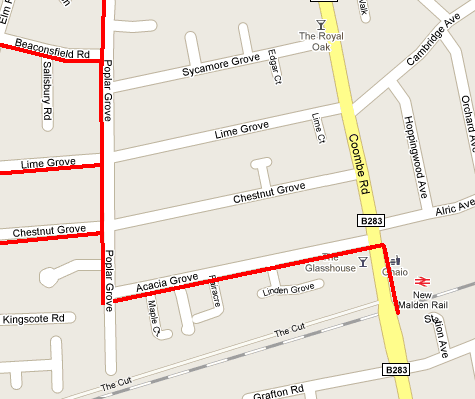
The Groves area of New Malden, showing the route almost everyone takes to get to the station.

The roads that I had initially thought were roughly the same length weren’t anything of the sort.

Lime Grove was a bit longer than Sycamore Grove.

Chestnut Grove was a bit longer still. And outlonging them all was the mighty Acacia Grove.

I sat back, my mind a blizzard of flurrying contradictions. What I had naively thought of as a rectangular grid-like pattern of roads – like Wandsworth’s famous toast rack – was no such thing. It was a quadrilateral alright, but with more of the unmistakeable characteristics of an isosceles trapezoid. Erk!

So why do people approaching from the north and west of Poplar Grove not take Sycamore Grove? One reason is that they don’t really give a toss how long their journey takes. The problem with this is that it would contravene the rock-solid hypothesis I posed in the second paragraph. We can’t have that.

The other reason is down to perception. I think there’s a widespread assumption that Poplar Grove runs parallel to New Malden High Street. So anyone approaching Poplar Grove would see the road they’re on appear to bend to the left, or north, after the intersection. In other words, it would seem to take them further away from their destination.

That would conflict with the shortest-route-possible principle. So instead of taking Sycamore, Lime or Chestnut Groves, most people will walk past all three and take Acacia Grove instead. The longest route possible but, according to their perception, the shortest.

Longest, that is, apart from The Cut. The Cut is a path that runs alongside the railway line. It’s quite a pleasant walk, but for some reason almost everyone snubs this route. I have no idea why.

Nest week, how to drive at speed between steel bollards.

6 Comments

Filed under New Malden, Stuff

My first rant

Not ever, obviously. You don’t reach your half century without regularly and with ever more irritation being enraged by the actions or opinions of others. I just mean that this is the first rant that I’m going to blog about. My first blant.

Here’s another qualifier: it’s not even particularly ranty. That’s all to do with timing. Six weeks ago I was seething with fury, now I’m just mildly amused.

So what’s brought on this disappointingly less-than-livid tirade? Two words. British Gas.

Faced with a winter energy bill that came eye-wateringly close to £1,000, I figured it was high time I added to the meagre amount of insulation in our loft.  I did some research and discovered that there were financial incentives in London (and probably elsewhere) for people to do just that.

25% of heat can escape through the roof. Fact.

In London it works like this.  British Gas come and do the work for you, you pay them the total cost on completion of the work then at some point in the future you get £100 back from the Mayor’s office.

So if your loft costs £230 to get insulated, you end up paying £130. I know I didn’t really have to explain that like you’re a six-year old, but misunderstandings seem to be the recurring motif of this little story so I hope you’ll excuse me.

Stage 1 – the survey

So, back in January I rang BG to book a slot. The home insulation message is clearly getting through as the earliest appointment they could offer was late April. Timing was quite critical as we were planning to have the hall and landing decorated in the Spring, and if BG insulation people were

25%. Kyuh!

going to traipse through the house lugging huge rolls of foam, I’d rather they did it before we had pristine walls and a new carpet.

April was still OK. However, the appointment turned out to be not for having the work done, but for having a survey.  To see if my loft is suitable.

It might not be suitable, you see. It might be one of those lofts that’s just resistant to insulation; that actively repels it in a Stephen King sort of way. Or the loft might already be knee-deep in insulation, rendering the exercise pointless. Or it might not be a loft at all but the living room of the upstairs flat.

These possibilities have to be checked out.

Experts are agreed.

So the official British Gas Loft Surveyor came round at the allotted time and, credit where it’s due, carried out the survey without a hitch. Flawlessly, even, although that’s probably not a word that should be used in a climbing-into-other-people’s-lofts context.

He took measurements and notes and left me with a big file explaining how it all worked. We shook hands and off he went. Then the fun began.

It's always 25%.

BG called me to arrange a date for the actual work to be carried out. I’m freelance, so taking a day off normally means foregoing a day’s pay. Then an idea struck me. ‘Do I actually have to be there?’ I asked the BG lady. ‘Not really,’ she said. ‘As long as there’s someone there to let the men in.’

Leigh would be there. He’s our trusty painter and decorator, and he’d be starting that very Monday. He could let the guys in and, when they were done, hand them the cheque that I’d leave behind. ‘Who should I make the cheque out to?’ She told me, and we were all set.

Insulation day!

Monday came, and half-way through the morning I rang Leigh to ask if the home insulation people had turned up yet. ‘They’ve been and gone,’ he said.

‘Wow, they were quick.’

‘Nah, they didn’t do anything. They just looked at the loft and left.

‘Looked at the loft and left?’ I laughed.

‘Yeah. They said someone would call you.’

And sure enough, someone did. The BG guy explained everything. Apparently they’d sent the wrong kind of insulation people.

‘You’ve got a long drive, and they couldn’t get the hose all the way up.’

‘Eh? What hose?’

‘To blow the foam in.’

‘But I thought I was having rolls of insulation.’

‘Yes. That’s what it says here. They must have sent the wrong team. They just do the blow jobs.’

Blimey, I’m glad I wasn’t in.

So we re-arranged, choosing another day when Leigh would be there, painting and pasting.

Insulation Day, Slight Return

I’m at work. The phone rings.

‘British Gas here. The insulation team turned up at your address but there’s nowhere to park.’

‘I moved my car out of the way so that they could park in our driveway.’

‘The van is too big.’

Confirmation of that 25% figure.

‘They can park in front of the driveway.’

‘They’re not allowed to block driveways.’

‘How about they dump the stuff, and one guy stays with it while the other goes off to park the van?’

‘They’re not allowed to do that for health and safety reasons.’ I struggled to see the threat to either health or safety in such a plan, but let it ride.

‘So they’re just driving around looking for a parking space?’

‘No. They’ve gone. You’ll have to rebook.’

This is in the suburbs, for heaven’s sake. How on earth do British Gas vans ever cope in the more densely populated streets of inner London, or inner anywhere? Perhaps their surveys should take as much notice of the local parking situation as they do on ensuring that the loft is a proper bona fide loft and that it is correctly situated in the space between the ceiling and the roof.

Where a loft should be.

There was a slight hiccup in that Leigh would have finished painting by the time of the next available appointment, meaning I’d have to take time off from work, but my daughter came to the rescue by saying that she’d be home from college on the day in question. It was a momentary respite, however.

‘How old is your daughter?’  At the time, she was a couple of months shy of 18. Which wasn’t acceptable. Someone has to sign the forms saying that the loft has been insulated, and that someone has to be an adult. Understandable, I suppose.

Son of the Return of Insulation Day

So I ended up being at home to welcome the BG insulation technicians. After having a word with the neighbours I managed to conjure up a parking space for their van, and they started unloading the rolls of insulation.

‘Have you got a ladder?’ one of them asked.  I found this very strange; that two guys whose sole job consisted of climbing in and out of people’s lofts didn’t have a ladder of their own.

‘Er, yes.’

‘What type is it?’

This was getting surreal. Were they setting me up for a step-ladder joke? (‘I have a step ladder.’ ‘So…it’s not your real ladder?!?!!!11′). Or would the description of my ladder enable them to somehow adapt the insulation-laying operation? But neither of those was the question really I wanted to ask.

‘Sorry but, you know, don’t you have one?’

It turned out be another misunderstanding. They meant did I have one of those loft ladders that glides down when you pull a rope or flick a switch or something. I didn’t. In fact, I lust after such a ladder. But had I owned one, they wouldn’t have needed to use their own. Suddenly it made sense.

The payoff

They used their own ladder and got the job done in around an hour. I signed the form to say that they hadn’t broken anything and handed them the cheque. But the head honcho explained that they weren’t able to accept cheques. ‘You don’t pay us,’ he said. ‘Head office will ring you, probably within the hour. You pay by card over the phone.’

Was this the same office that told me who to make the cheque out to? Right hand, meet left hand. The hour went by without the call. Then the rest of the day. Then May came and went. Then June.

And this is why I’m amused rather than angry. To date, no one has asked for payment. So although I lost half a day’s pay, I’ve had my loft insulated free of charge. Here’s to incompetence.

4 Comments

Filed under Stuff