Tag Archives: kevin mills

Jokes

I need to finesse my ChatGPT briefing skills This is supposed to be people in a pub listening to a joke.

When people used to congregate in pubs in large numbers and with great frequency – this is going back a few decades – they’d often end up telling jokes. Some were good, some were bad and there were many that you wouldn’t want to tell, much less hear, today. But they’d always be preceded by the joke teller saying something along the lines of:

‘Here’s a good one…’

‘Reminds me of the one about the…’

‘Did you hear the one about the bloke…’

‘Stop me if you’ve heard this one…’

So not only did everyone know that a joke was coming, they also knew that it had been told before; that it was a joke that was ‘doing the rounds’. It didn’t make the jokes any less funny that you knew this (assuming they were funny at all, but even then most people would chuckle out of politeness or early-onset drunkenness), but it did mean you knew the tellers hadn’t made the jokes up themselves. In my various circles of friends, colleagues and family members, I’ve never met anyone who’s actually made up a joke. And yes, I have asked. A timely bon mot or rejoinder, definitely. They can be funny as hell, but they’re generally of the moment. They don’t suddenly get shared by groups of people in pubs. If the exact same circumstances that provoked the funny response were to happen again, elsewhere, and you were there along with a group of people who hadn’t witnessed the previous occasion, and you remember the wording of the witty response and you get the timing right, then yes. You could pass it off as your own smart witticism and bask in the glory. But it’s a big if.

But something has changed. Well, a lot’s changed. People don’t go to pubs quite as much or as often as they used to. And when they do, I’m pretty sure they don’t stand around regaling one another with jokes. (I’m happy to be corrected on this.) People are still telling jokes on social media. But they’re not of the shaggy dog variety, with long set-ups before a (hopefully) side-splitting punchline. And they’re not snappy little knock-knock jokes, either. Jokes online generally include funny responses to items in the news, or comments made by public figures; or they’re observations about the human condition and the craziness of modern life. And they can be fucking hilarious.

The biggest change for me, though, is how people are quite happy to pass off what for the sake of brevity I will call ‘gags’ as their own work. I didn’t notice this trend on Twitter, but it’s rampant on Threads. People see a gag and instead of reposting it, they’ll go to the trouble (OK, it’s not THAT much trouble) of copy & pasting, just so that it looks like the product of their own wonderful sense of humour.

Why do people do this? I mean, it sometimes works if what they want is a few hundred likes and maybe a few extra followers, but what else in in it for them? And how does it make them feel? ‘Wow, that gag I nicked was really popular! I must steal more stuff from other people and develop a greater sense of fraudulently acquired self-esteem!’

I don’t get it. But then I’m someone who still laughs at doctor-doctor jokes.

2 Comments

Filed under Stuff

Mike Oldfield and Microcopy

The year 2024 marks the 50th anniversary of Mike Oldfield’s Tubular Bells reaching the summit of the UK album charts. The music probably sounds ploddy and pedestrian to today’s listeners, but it had a huge impact on the youngsters of the 1970s. And not just amongst the hippies.

Oldfield’s debut solo album went on to sell 15 million copies and spend an aggregate of five-and-a-half years on the UK chart, although it only reached number one some fifteen months after it was released. (Coincidentally, the album it knocked off the top spot, pop quiz lovers, was Oldfield’s second solo outing, ‘Hergest Ridge’.)

I listened to Tubular Bells again and again, simultaneously studying every word of the sleeve notes. That’s what people did in those days. That’s what I did, anyway. ‘Cover by Hipgnosis’. ‘Packaging by Shorewood’. ‘Jack Bruce appears courtesy of ECM Records.’ I lapped it all up. For a really good examination of the way the LP shaped our lives back then, I thoroughly recommend David Hepworth’s evocative book about the era, ‘A Fabulous Creation’. Anyway, it was on the back cover of Tubular Bells that I first came across an example of what we today call microcopy.

First, a bit of context. It had been standard practice since the introduction of stereo records to include a paragraph warning about the dangers of playing the album on incompatible mono equipment.

(Small print from the back cover of Frank Zappa’s ‘Hot Rats’)

The message was more or less redundant as stereo had been around for a decade or more. I’m pretty sure no one was ever in sufficient doubt as to feel the need to ‘consult their dealer’. But still, there it was, sitting awkwardly straightlaced on albums by The Electric Prunes and Captain Beefheart, an ever-present reminder of finger-wagging officialdom staring up at you as you roll your joint.

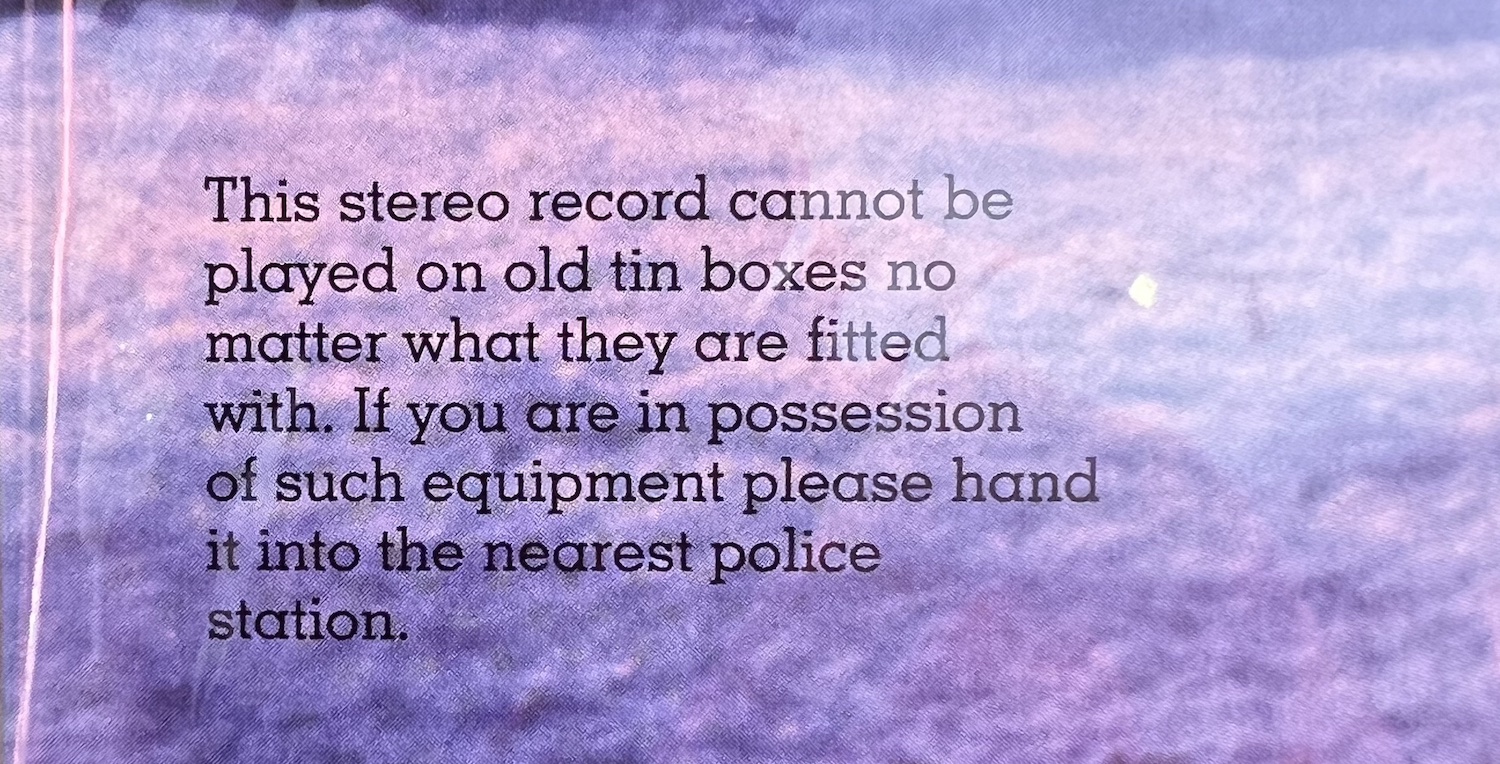
But then Tubular Bells arrived. With its many themes and layers, its complex time signatures and the (for then) unconventional use of multiple overdubs, it was music that demanded to be heard properly. So some bright spark at Virgin – this was the newly established label’s first release – decided that the boring, over-familiar message on the cover could do with a bit of a rewrite.

To my young eyes, this subversion of the official message merely added to the overall effect the music was having on my young ears. It was confident and funny, and you couldn’t argue with the sentiment.

That first sentence is the killer. ‘Dead right’, you think to yourself. ‘Thank god I exchanged my Dansette Bermuda for this swanky new Sanyo G2611 Music Centre’. The second sentence probably raised a smile back in the age of Python and Milligan, but today I look at it and think they could have tried a little harder. Even ‘hand it into your nearest museum’ works better.

I reckon this was my first exposure to what’s now known in copywriting and UX (user experience) circles as microcopy. It’s when a writer looks beyond the headline and the main ‘selling’ text, and starts thinking about the incidental stuff – the add-ons, the mandatories, the everyday nuts & bolts.

The aim is to add an extra something. That could mean helping a user navigate a website in a simple, friendly way, writing an email’s ‘snippet’ – the line of text you see before you open an email – to make it more engaging, or just having a bit of fun with some boring bit of instructional copy. Done well it can make the reader feel warmer towards a brand. But overdo it or get the tone wrong and the reader immediately sees what you’re trying to do and thinks ‘oh FFS give it a rest!’

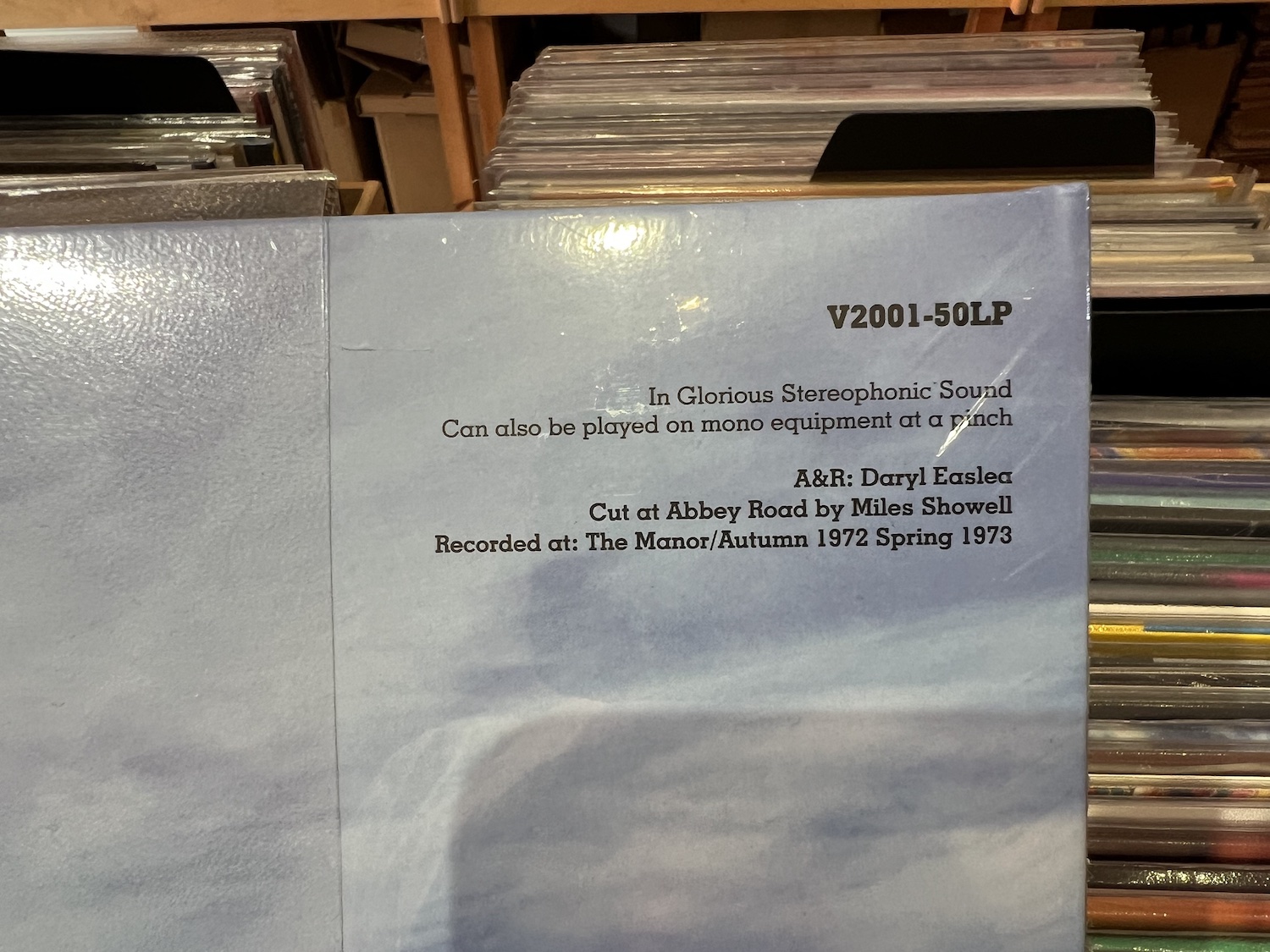
Incidentally, the sleeve-note writer of the 50th anniversary issue of Tubular Bells (it was released in 1973, remember, not reaching number one until a year later) had a go at updating that iconic paragraph. It’s shorter (good) and at least tries to retain the same tone (also good), but with mono record players not being a thing for over 60 years and everyone who owned one being dead, I’d argue that it didn’t need to be there at all.

Have you been impressed by any examples of microcopy? Or seen other examples where the writer should have reined it in? Tell me about them.

Leave a comment

Filed under Stuff

The Dead Trees of Richmond Park

No. 64. Cause of death: Varicose Rings

No. 291. Cause of death: Multiple Bough Failure

No. 230. Cause of death: Despair

No. 616. Cause of death: Leaf Trauma

No. 928. Cause of death: Arboreal Imposter Syndrome

No. 417. Cause of death: Apathy

No. 668. Cause of death: Trunk Stunt

No. 288. Cause of death: Currently Under Investigation

No. 836. Cause of death: Sudden Bole Death

No. 440. Cause of death: Treasles

No. 106. Cause of death: Pointing Sickness

No. 602
Cause of death: Acute Foliage Envy

No. 551. Cause of death: Taproot Corpulence

Nos. 738 & 739. Cause of death: Suicide Pact

No. 399. Cause of death: Shame

No. 502. Cause of death: Limb Overreach

No. 988. Cause of death: Angler’s Arms

No. 518. Cause of death: Chronic Self-Doubt


Leave a comment

Filed under New Malden, Stuff

In defence of Social Distancing

Saatchi & Saatchi could have gone with ‘Labour’s Double Knockout’ for their Tory posters in the 1992 election campaign. Instead, they used the line ‘Labour’s Double Whammy’.

Nobody had heard or read the phrase before. All that stuff about speaking to your audience in their own language, use familiar words and phrases, assume at best a nodding acquaintance with the English language – all that was quietly dropped in favour of an expression that was new and alien.

Soon after the ads appeared, the newspapers were full of comment pieces about the wording. Where did ‘double whammy’ come from? What did it mean? Who dreamed it up? (Chris Patten, allegedly.) Was it an *gasp* Americanism? (I’d heard of the whammy bar, but that clearly wasn’t relevant here).

The public didn’t care about its provenance. But they could grasp exactly what it meant. And the expression is now firmly established in popular language.

This is why I don’t think we need to worry too much about the phrase ‘social distancing’. It might not be perfect. ‘Spatial distancing’ might convey the intended meaning more accurately, although it is a bit sci-fi. ‘Physical distancing’ sounds like something Gwyneth Paltrow might do. I said might. ‘Keep two metres away from each other’ sounds Ronseally straightforward until you remember that you’d have to include the imperial equivalent to appease the Daily Mail and its army of Little Englanders.

But from my observations, people are very quickly starting to learn what social distancing means to them in their daily lives. Sure, there’ll be those who choose to flout the advice, just as there are those who insist 40mph is okay in a 30mph zone or who see nothing wrong in dropping litter. 

Sometimes, an unusual phrase is what’s needed to get standout and provoke a reaction.

Leave a comment

Filed under Ill-informed advertising observations, Stuff

Making a headline from the Ts&Cs

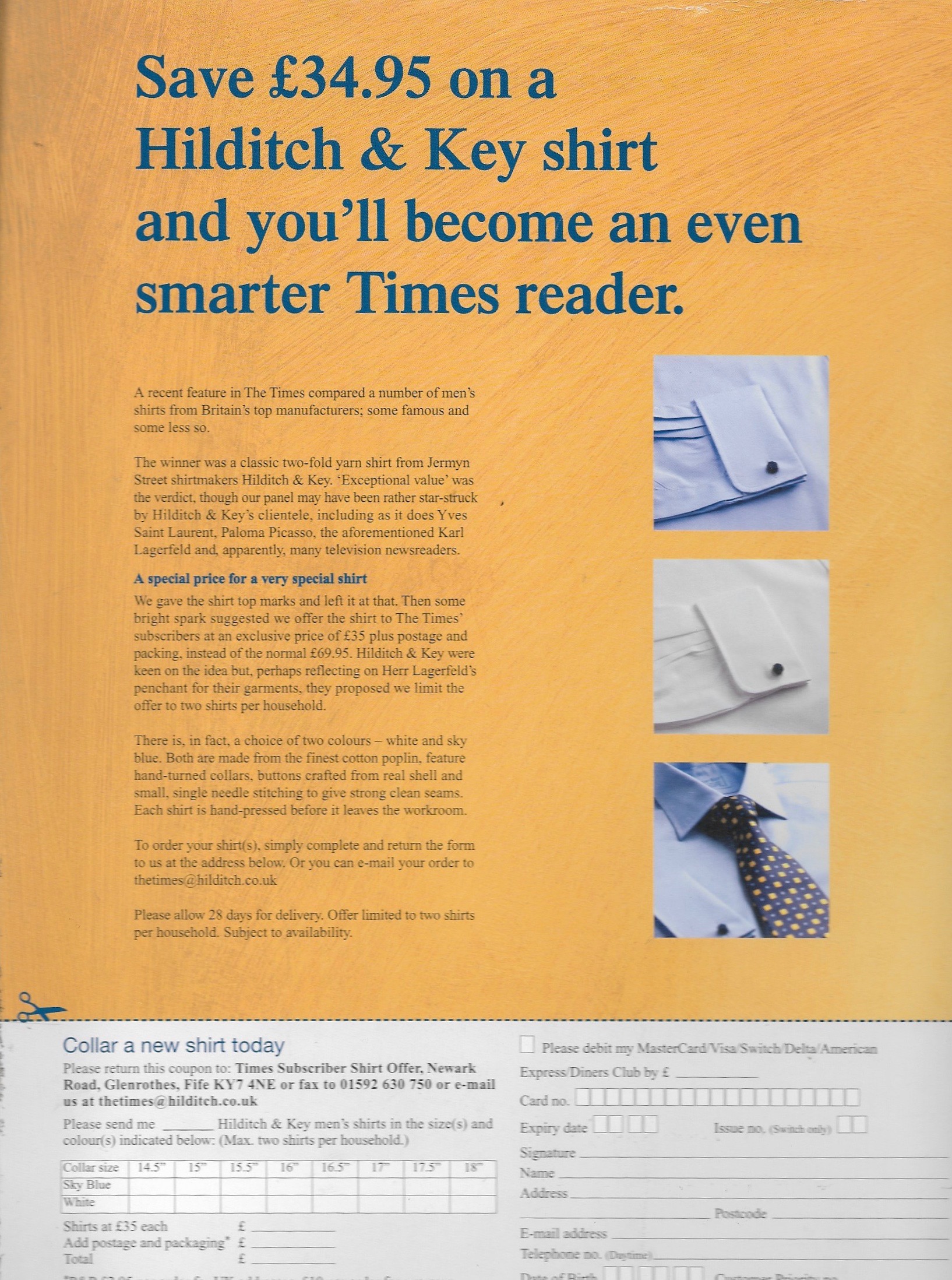
Back in the day I had a brief to write an insert selling Hilditch & Key shirts to readers of The Times.

It was basically a half-price offer. So that could have been my headline. ‘50% off Hilditch & Key shirts.’ That would have worked. But, and this is where brands and how they sound comes in, would it have felt right? Both The Times and Hilditch & Key deserved better, I thought. You can always slap people about the chops with ‘Half-Price Bargain!’ and ‘Save £££s’ type headlines, but this wasn’t the occasion.

So I did some research about Hilditch & Key (a brand I hadn’t previously heard of) and learned that their shirts were popular with big names in the fashion industry. Yves Saint Laurent. Paloma Picasso. Karl Lagerfeld. In fact, I learnt that Lagerfeld was a proper little H&K fanboy, snapping up more than a hundred of their shirts every year. Weirdo. Anyway, I also read the terms and conditions attached to the offer. Don’t you do that? I thought all copywriters did that! No, I only did because of the Karl Lagerfeld thing. Lo and also behold, there it was: a term, or perhaps a condition, stipulating a maximum of two shirts per household. And with it, there was my headline.

Eye-catching, name-dropping, a bit cheeky, an air of exclusivity, and true to the brand values of both The Times and Hilditch & Key. Details of the offer went on the reverse.

Like I say, the insert might conceivably have sold more shirts if the headline had read ‘BUY NOW AND SAVE 50% ON CLASSIC SHIRTS!’, with a couple of flashes, all the copy in Courier, a call to action on every line and a bigger scissors graphic. But sometimes – hell, always – it’s about the brand.

Art Director: Tony Henry

Note: If you squint you might be able to detect a semicolon on the second line. Strictly illegal these days, a semicolon was sometimes used to indicate a pause shorter than a full stop and longer than a comma. What WAS I thinking. 

2 Comments

Filed under Ill-informed advertising observations, Stuff

Not, I’d say

Remember Shreddies’ knitting Nanas? Launched in 2009, the idea was that hundreds of Nanas lovingly knitted each Shreddie to ensure they were all absolutely perfect. The campaign highlighted Shreddies’ unique design and taste. Some found it off-putting (‘yeuch, wet wool touched by olds’) but the campaign was a success and lasted for years.

But then it eventually ran out of steam, or yarn, and something new was needed. And this is it.

‘Shreddie…OR TOOK THE BOYS BACK TO SCHOOL, (A DAY TOO EARLY).’

So the campaign idea is that you should have Shreddies for breakfast or you’ll end up doing daft things or be otherwise unprepared for the day. It’s basically a twist on the famous Weetabix campaign from the late 1980s that’s just been resurrected in a new spot by BBH. Instead of ‘Have you had your Weetabix?‘ the line is ‘Shreddie or not?

It isn’t a bad thought. Weetabix obviously rate it. McDonald’s tread the same path, too, with ads featuring people wearing mismatched socks because they didn’t start the day with an Egg McThingy.  And to be fair, the TV commercial from Shreddies’ agency McCann is reasonably amusing.

But these posters. Oh my. You might conceivably get half-way to work before remembering it’s a Sunday, or drive to the park to walk the dog before realising that you remembered the dog lead but not the dog. But is parents taking their children back to school the day before terms starts a recognised phenomenon? Why does the ad just talk about boys? Why is A DAY TOO EARLY in brackets? Why is the opening bracket preceded by a comma? Couldn’t they have got a copywriter involved at some stage of the approval process?

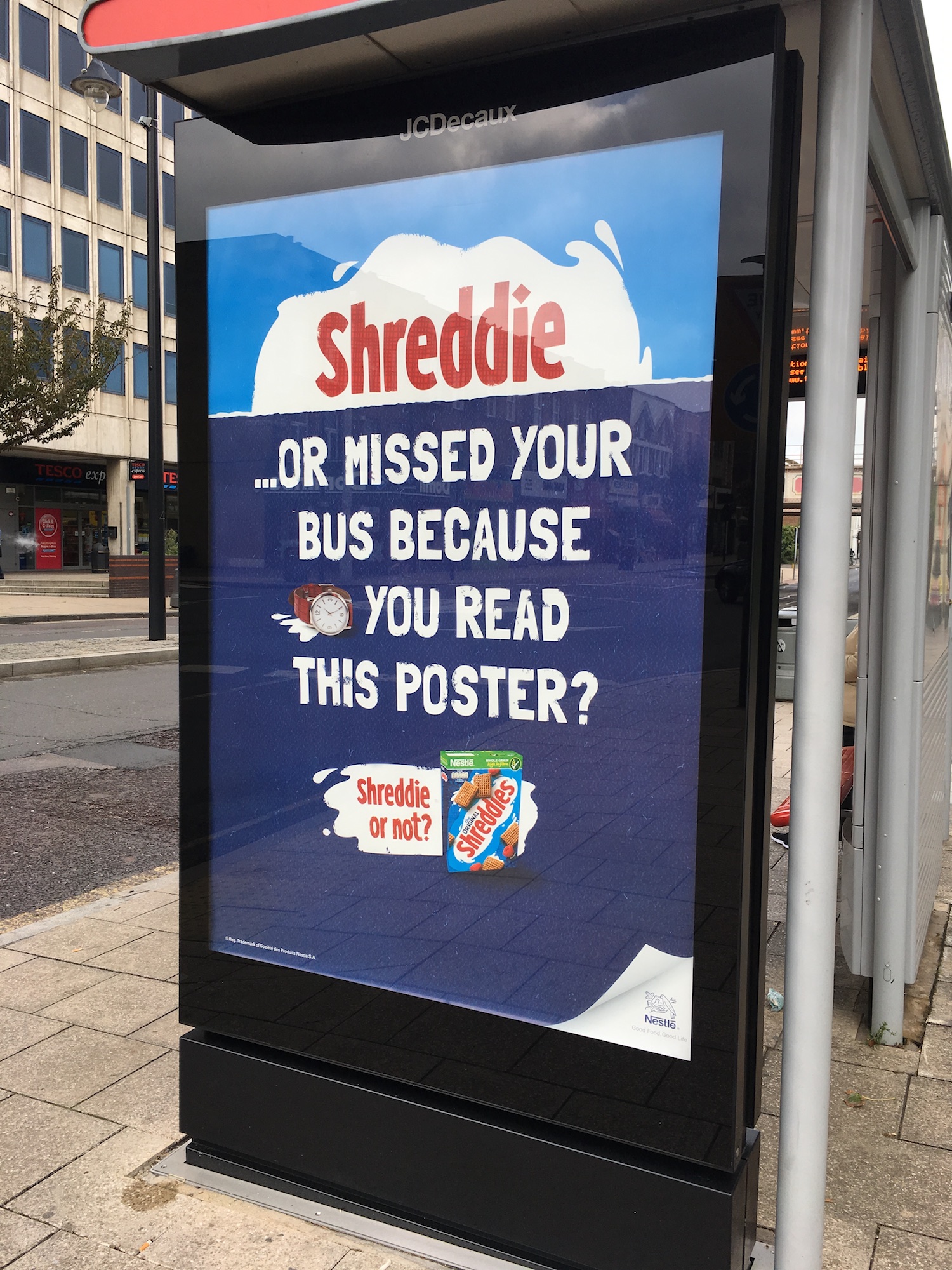
Things take a turn for the worse with this next execution. That old chestnut about people deliberately missing tube trains because the copy on a cross-track poster was so captivating might hold some truth. I doubt it, but you never know. But is it even remotely likely that someone would dwell for so long while taking in just 10 words of text that their bus would come and go before they’d reached the end?

I admit that I spent more than a few moments staring at it. But that’s because I couldn’t believe the arrogance of it. I’m ambivalent at best towards the idea of breaking the fourth wall in advertising. It often reeks of smart-arsery. (I warmed to the Oasis campaign after some initial hesitation.) But this is self-congratulatory bollocks. Now you might say hey, we’re in adland here, Mr Literal!! Take a relax pill!!! I’d say you can think about what your ad is going to say for LONGER than seven seconds and STILL have fun. You might even sell some cereal.

I realise I’ve probably blown any chances I’ve got of f’lancing at McCanns, remote though they were. But bloody hell.

Mind you, the campaign does inadvertently have one redeeming consequence. Because every poster site displaying one of these Shreddies ads means one less showing you-know-who.

image courtesy @zacharyking

7 Comments

Filed under Ill-informed advertising observations

Party Girls of Piccadilly

Some years ago I was wandering around the Vintage Magazine store in London’s Brewer Street, looking for inspiration for an ad campaign I was working on. I came across an old magazine that, while being no use at all for the job in hand, was absolutely amazing for loads of other reasons.

Male magazine front cover

Now that’s what you call shelf appeal

Male was probably irresistible to certain male browsers back in June 1955, just as it proved to me some 35 years later. I must have drawn some strange looks on the tube as I started reading it on the way home.

The leading article about an intrepid American hunter bravely slaughtering a Komodo dragon was appallingly exhilarating, as were the pieces entitled ‘I Alone Survived’, ‘My Legs Began To Rot’ and ‘We Flew Down Eagles’, a how-could-he story about a Texan farmer who rigged up a gun mount on his Piper Cub aircraft so that he could shoot soaring golden eagles more easily than from the ground.

I’m a sucker for old-school direct response ads, too, and the ones in Male are masters of the form. There’s the obligatory full-page ad for Charles Atlas (‘simply utilize the DORMANT muscle-power in your own God-given body!’), ads for book clubs, hunting knives and uranium detectors, ads for dodgy-looking correspondence courses (including one on mastering correspondence), a riff on the famous John Caples ‘They Laughed When I Sat Down To Play The Piano’ ad, and a few ads aimed at helping men become better men through mending things: ‘FIX ANY PART OF ANY CAR IN A JIFFY!’, ‘Learn To Fix Appliances’ and ‘I Will Train You At Home for Good Paying Jobs in Radio And Television’ (Again, he means fixing them rather than becoming the next Jack Benny).

But the article in Male that I’ve recreated here (aka laboriously typed out) is Party Girls Of Piccadilly, a searing exposé of the vice scene in post-war London. Given the passage of time and the sensationalist style of reporting that Male demanded from its contributors, it’s difficult to say how much of what follows is an accurate snapshot of 1950’s London. Alfred Kinsey’s testimony to the 1954 Woldfenden Inquiry (to which this article alludes) asserted that London was second only to Havana in the proliferation of its prostitutes, but even so, the authors of this piece seemed to bump into a hooker every few steps.

See what you think. The subheads are mine, by the way. They’re just there to break up the copy. It’s a bit of a long read.
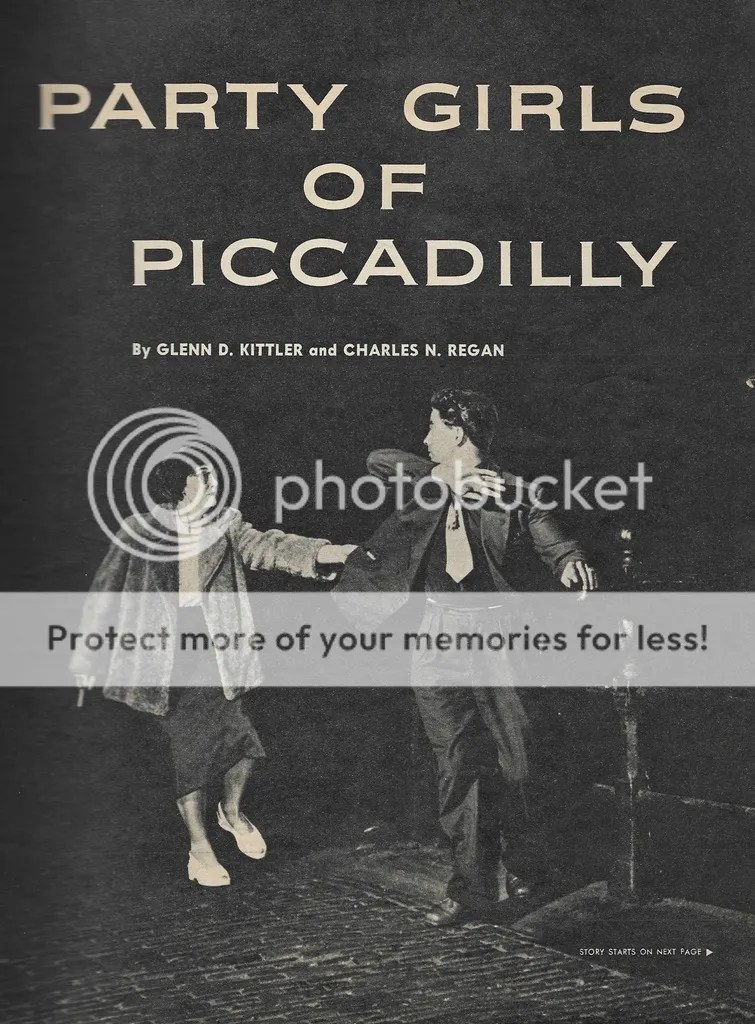
At eleven o’clock every night the streets of London erupt in a rush hour of prostitution. The bars close; thousands of men down their last beers and hit the sidewalks for home – with girls propositioning them every step of the way. Soliciting is bold and uninhibited.

From the lowest Soho back alleys to the sidewalks outside Mayfair’s swankest lounges, London streetwalkers ply their trade with a frankness hardly equalled anywhere in the world. There are thousands of these women.

Last year 9,000 were arrested in the metropolitan section of London alone – arrested not for prostitution but because their health cards indicated they had skipped the semi-monthly medical examination.

The indifference to this form of vice surprised us. Until we saw it for ourselves, we couldn’t believe that so many women were making a living from kerbstone solicitations.

Britain’s rugged history

In quest of an explanation we visited C division of the Metropolitan Police, which has the unhappy task of overseeing most of the sidewalk activity. There we were told that the increase in commercial vice is simply a by-product of the rugged history of Britain’s most recent 15 years.

A lieutenant told us “During the war, there was the usual let-down in morality. But matters continue to deteriorate even afterwards. For the country on the winning side of, World War Two we are certainly pay a loser’s price. Post-war shortages put us on a depression economy. Rationing deprived us of a full measure of basic necessities. Dim-outs saved vital electric power, but cut down our social life.

Women turned to prostitution because they needed the money. Men turned to prostitutes because of tension and insecurity and, I suppose, because there was often nothing else to do.”

From our observations, the supply of women far exceeds the demand. In Piccadilly, the Times Square of London, we saw groups of eight and ten girls strolling around like schoolgirls on a gay visit to the big city.

The difference was that they accosted every man they saw, offering him a choice of any girl in the group – or the entire group, if he wished. London streetwalkers stand out in a crowd, like cabbages among apples. Even at high noon they make themselves obvious and prevalent.

Hip swing

Streetwalkers in mink and streetwalkers in rags, whether in London or Paris or New York, all use the same trademark: the slow walk, the enticing hip swing, the dangling purse, the prolonged meeting of eyes.

Because of peculiar police regulations which legitimise streetwalking and stamp out all other forms of the ancient profession, London prostitutes differ from each other mainly in price.

As might be expected, the more attractive, well-groomed and intelligent ones are able to charges as much as upper-crust courtesans in recently-exposed New York call girl rackets. The tariff sometimes runs to more than 100 pounds for an evening. (A British pound is worth $2.80.)

The majority fall into the 10 to 30-shilling ($1.40 – $4.20) range, though we were told it is possible to find some who place even less value on their work. The 10 to 30-shilling types are neither homelier nor more attractive than run-of-the-mill harlots elsewhere. Good posture and clear eyes are rare, although the blooming complexion of rural England is sometimes seen.

Eight harlots per minute

The girls in the middle price brackets, and even some who ask a lot more, mingle with each other on the same street corners and cruise the same blocks. On an afternoon walk from Piccadilly along Coventry Street, down the Haymarket to Trafalgar Square, we counted 40 at work. That night, taking the same 25-minute stroll, we spotted almost 200.

Subsequent excursions along the same route enlightened us to the fact that the girls work favourite ‘beats’. We always saw the same girls, just as we later saw familiar faces operating in specific sections elsewhere in the city.

Usually, the girls are as friendly to each other as neighbors who meet in a supermarket on the Saturday shopping expedition. We saw them stop and chat and trade cigarettes. One night we heard a man ask for a particular girl, and her colleagues happily pointed her out in the shadows of a shop entrance.

But on slow evenings and at late hours, friendship goes down the drain. Late on chilly night in Shepherd Market we saw three young girls fighting over an American sailor.

In an alley off Trafalgar Square we saw two older women almost rip a man in half as they tried to pull him in opposite directions.

And outside a crummy bar in Glass House Street, where many prostitutes live, we saw women battling for position in a line formed outside the door. As each man made his exit from the pub, the girls would shriek at him, often plucking at his sleeve to get his undivided attention and, hopefully, his trade.

If the man is willing, he walks with the woman of his choice to her ‘digs’, usually an ill-lighted, shabbily furnished room which may service for living quarters also. Only the most successful can afford to pay double rent. Some take their customers to one of the lesser hotels, though this risky for everybody.

Sorry, this is from another article

Sorry, this is from another article

Lucrative business

Despite their moderate fees, even the 10 and 15-shilling prostitutes claim to average 20 pounds a week – about $50. In view of the low tab, this indicates considerable activity. We talked to two sorry-looking sisters, 19 and 21 years old, who said they had managed to save $2,500 in six months of flesh peddling.

They told us they were from Ireland, which brought to light the fact that many of the middle class girls are imports. With many Irish girls the pattern is common: husbands and jobs are hard to find at home, so they leave their impoverished families to work in London as hotel maids or waitresses.

Girls come to London from all over the Empire. Many merely want to escape the drabness of economically unstable homes in remote colonies. Others seek movie or stage careers or just ‘any old job’.

Many know in advance that they are going into prostitution and arrive in London with the idea that they are invading the world’s best market. Whatever the cause of their choosing prostitution as a career, the girls land on the streets.

The pickings are apparently easiest for those who charge the highest fees. Although they are technically streetwalkers, these elite tarts seldom fate forth more than once a night and often work only once or twice a week. Some of them are actresses, models or showgirls who are either temporarily out of work or have become used to extra income.

£25,000 a week!

These are the girls who most closely resemble American call girls in that, after they have established themselves, they do not have to prowl the streets. The customers often become regular clients who make appointments by phone. One woman told us she earned £980 – $2,744 – in one week. (Me: that’s about £25,000 in 2017 prices!)

Unlike the quickie artists of Soho (London’s run-down equivalent of Greenwich Village), the ritzy prostitutes expect dinner and a few drinks from their clients, even if the transaction originates on a sidewalk.

Later, the woman takes John Customer to her elegant apartment, usually in the Mayfair or Sloane Square regions. The man knows he is expected to spend the night, stay for breakfast and deposit the girl’s ‘gift’ with the maid as he leaves.

Payments vary from $50 to $350. Men who can afford it visit the same girls regularly, thus assuring her of a decent income and keeping her available.

Because of their aristocratic appearance, some of the more luxurious women are permitted to sit in the lounges of good hotels and sip drinks while waiting for a pickup. However, an overt gesture of solicitation by even the most elegant prostitute would be enough to put her out on the curb. All the top-notch pros try to work London’s best night spots, but an alert management is generally able to keep them out.

Strangely enough, the girls also follow social custom and have divided themselves into sharply demarcated social classes. We didn’t meet one who aspired to higher prices or resented the plush lives of her more successful sisters. A ten-shilling girl told us “I know my place. I know the kind of men I can get, and I know the kind who wouldn’t touch me. I do all right.”

For this sort of girl, ‘doing all right’ means earning a mere living and enjoying no luxuries. She lives in a small flat, sometimes alone, but surprisingly often with another prostitute who is her intimate friend.

Britain’s growing problem

We were astonished at the number of these women who not only display the prostitute’s traditional dislike for men, but are able to generate romantic feelings only for other women. As scientists have stressed in recent years, homosexuality is a growing problem in Britain.

Another rather unfamiliar aspect of London prostitution is the absence of the male scrounger, or procurer. Streetwalkers do not saddle themselves with ghastly boyfriends who can be found lurking around American tarts.

The British woman does her own soliciting and, if she has a lover, he is seldom associated with her business. Possibly the only men who make money from London prostitutes are the comparative handful who are paid to protect women who are in violent competitive feuds with others.

Also, in some of the worst sections, she may employ a man to act as lookout and warn of approaching police, but that’s the extent of their business dealings with men.

London bobbies stay on the same beat for years and get to know local prostitutes by their first names. The bobby has two jobs in this connection: to keep the competition from getting too violent, and check health cards. All London prostitutes carry the cards, issued by the city and checked regularly at St Thomas Hospital.

If a policeman finds that a girl has missed her check-up or is operating with a card that labels her as diseased, he runs her in. For this offense, as well as for street fighting, the court fine is 40 shillings. The girls are by now so accustomed to the fines that the call them ‘our income taxes’.

Outside London

We wondered about the ‘taxes’ elsewhere in England, and a tour of the country revealed that the provinces are jolly well holding their own. In Manchester, an industrial centre of 700,000, we were told of an official study which disclosed that 400 streetwalkers worked the town and that many hotels were hospitable to their trade.

In Newcastle, a seaport, prostitution flourished so disastrously after the war that an enlarged police force was given orders to patrol all streets every 20 minutes and arrest all women who appeared to be loitering.

Cardiff, once the roughest town in Great Britain, had so many police on the streets that we thought the town had been invaded. Prostitutes were not to be found.

Right, back to the capital

Evidently, the pressure in the provinces has served to heighten the concentration in London. There, in the world’s largest city, they all have room to maneuver. In Park Lane, where expensive hotels overlook Hyde Park, we saw one woman accost 30 men in less than an hour. Rebuffed but undiscouraged, she tramped on, until the last we saw of her she was strutting across the street and into the park.

In Soho we saw two British soldiers approached four times by elderly women who greeted them with ‘Got the time, dearie?’

In the Bayswater Road area, we noticed a large number of car pickups. The cars took off to the rows of apartment buildings near Paddington Station.

Tenants of those apartment houses have complained bitterly that the night traffic in the neighbourhood resembles a parade. Resultant raids occasionally net a few girls who are charged with disturbing the peace, but the clean-ups are so ineffective that they are conducted half-heartedly.

Floating crap

Another police headache are the groups of girls who try to set up parlour houses. They take short leases on apartments and small houses and take turns outdoors, drumming up business for each other. For the police, locating the establishments is somewhat like trying to track down a floating crap game.

In Leicester Square, we got an invitation to visit such an establishment, described to us by a sallow teenage girl as ‘the club’. She assured us that there was no admission fee and that the selection was varied. Asked for a rain check until the following week, the girl said ‘who knows where we’ll be next week?’

Present headquarters, she said, was over a pub and, though the owner enjoyed collecting the high rent, he feared that police would spot the traffic. Being caught would mean his license.

Many such youngsters, we learned, actually live with their families, spending what time they can soliciting customers. They are the most youthful of daytime streetwalkers and usually return to their homes in the late evening, when the old-timers hit the sidewalks.

Trollops

Though London has always had its share of commercialised vice, the problem, according to police, has never been as great as it is now. At one time, a high percentage of the trollops were foreign, coming over from Paris and berlin when travel was easier and prices higher. The war finished London for the Germans, and the French who arrive now are in the elegant higher brackets.

It was the war, say authorities who should know, that brought on the current vice epidemic. Remnants of defeated European armies moved to England. The US sent over hundreds of thousands of men for the European campaign.

Thus London became a huge garrison playground. Operating prostitutes made fortunes, and gossip of their profits attracted newcomers. A sad but true fact was that Americans contributed largely to the decline.

Few English women had met any Americans before the war. Suddenly the country was jammed with thousands of fast-talking, fun-seeking, easy-spending Yanks who treated the women with a lavishness and intensity such as they had never known before. To Englishwomen, Americans were the greatest import since tobacco.

The girls went wild. Thousands left home in order to make themselves more available. Many hoped to marry Americans eventually, and some did. But the majority were left on the wharf, some, unfortunately, with illegitimate children to support. For hundreds, there was no recourse but to make their bodies public property.

Harlots

Post-war controls greatly restricted British life. Spending a night at beer and darts in his favourite pub was the only way an Englishman could spend his money – if he had any money to spend. Knowing this, the desperate girls learned to haunt the dark streets at night, hoping to find a man who would want them. As the years passed, prostitution increased, until today the British themselves admit that London has the largest population of harlots on the Western world.

Older members of this profession, unable to make out any longer, become charity cases. The outcasts often resort to robbery and mugging when other business is slow.

In an effort to improve this disgraceful state of affairs, a committee of fifteen eminent men and women was recently organized* and began casting about for solutions. The police told them, in effect: ‘Increased arrests will only cause a new problem. We don’t have enough room in our jails to accommodate that mob.’

But the picture is not completely barren of solution. Social workers point out, for example, that the British economy is becoming more robust. In some trades, jobs are going begging.

Honest

The London committee, believing that most of the streetwalkers would not have chosen their present calling had they have been able to find honest, fair-paying employment, hopes to organise a salvage operation. The girls will be encouraged to take jobs – if employers can be persuaded to overlook the past.

Should this campaign prove successful, and should the sidewalks become less congested, many Londoners will consider the time ripe to take the next step: fill up the jails, not with the girls, but with their customers. These observers are sure that once it becomes a public offense to patronise a prostitute, vice will approach the vanishing point.

The average Britishers are not losing any sleep waiting for this moral millennium, however. Being very practical people, they know that women will be wearing streetwalkers’ shoes for some time to come and derive comfort from the knowledge that as long as this must be, at least they’ll be wearing them in good health.

*This led to the Wolfenden Report.


3 Comments

Filed under Ill-informed advertising observations, London learnings, Stuff

Christmas Carols via Google Translate

Popular carols translated from English into several random languages then back into English. Everybody sing along!

Ding Dong Merrily on High

Ding dong merrily on high,
Heav’n ring the doorbell:
Ding Dong! The sky
The Angel singing riv’n.
Gloria in excelsis Hosanna!

Down so low e’en,
Let the bell swungen,
And “I io!”
Priests and people Sungen.
Gloria in excelsis Hosanna!

Please, first duty
Your Matin Carillon bell;
It may well frost
Your evetime song, you singers.
Gloria in excelsis Hosanna!

Silent Night, Holy Night

Silent night, Holy Night,
everything tranquil, everything it bright
Yon virgin mother J. Nino.
Santo Infant Tan tyerno J. Ramah Taman,
sleeps in La Paz sky. Sleep in La Paz sky.
Silent Night, Holy Night,
The Shepherds Tremble Before The View,
The Glorious Women of the Cycle Away,
The Heavenly hostesses canton haleloia;
Christ the Savior, noses! Christ the Savior, noses!
Night of Silence, Holy Night, Sons of God, pure Led of Love Riot Radiance of your Holy face, with the amaneser of the redeeming Grace,
Jesus, it ñ Ore, in your birth.
Jesus, it ñ Pray, in your birth.

The Twelve Days Of Christmas (final verse)

In twelve of Christmas, my true love sent to me
Twelve drummers, eleven tubes and flute
Ten Lords A- nine women dancing,
Eight Maids A-mil, seven swans swimming in water,
six geese, chickens, Gold, four birds of call,
three French chickens, two turtle doves and a partridge in a pear tree is!

Good King Wenceslas

Good king Vásla saw
Esteban Tour Information
Snow’s lie deep. Significance still
A bright moon shining in the night
Don abuse
It ended up poor
Fuel collection in winter
You and me
if you can,
What is a farmer?
How to find a place?
Teacher, he is a good agreement,
farm
Located directly on the trees
Sources of St. Agnes
My meat brings me wine
I brought sophisticated me here
You and I will have lunch.
When you wear.
The page and the king, they
I went
Bad air is wild
Pain and weather.

The First Noël

Noel angel
Fields are located to the shepherds of the poor,
When the sheep sector,
A cold night, and it was very deep.
Noel Noel Noel Noel
Born is the King of Israel!

They saw the star to watch
Eastern border is much better
And the earth with high beam
Thus continues day and night.
Noel Noel Noel Noel
Born is the King of Israel!


Leave a comment

Filed under Stuff

Born in ’54

2024 is the year I turn 70. No, I can’t believe it either. I wanted to know who and what I share my anniversary with, so here are twenty or so examples of others celebrating their 70th birthday this year.

SUNSILK SHAMPOO

Unilever first launched this famous shampoo in the UK. Now it’s the biggest name in haircare and is sold everywhere. A 1960s ad campaign for Sunsilk featured a jingle composed by John Barry that was subsequently released as a pop single. Don’t look it up, it’s awful.

UNIVERS

Univers is described as a neo-grotesque sans-serif typeface and was designed by a Swiss guy called Adrian Frutiger. Frutiger also came up with, er, Frutiger. Alas, Univers isn’t on the WordPress menu so you’ll have to settle for whatever this is. Palatino?

THE GEODESIC DOME

A strong yet lightweight structure consisting of a lattice of interlocking icosahedrons, patented (but not invented) in 1954 by American hippy hero R Buckminster Fuller. The best examples in the UK can be seen at Cornwall’s Eden Project.

SLIDING DOORS

Not the movie, the actual thing. One breezy day in 1954, a couple of Texan dudes noticed that the wind was always blowing swing doors open. So they set about inventing the world’s first automatic electric sliding doors. Today it is estimated that there are lots of sliding doors everywhere.

THE MOGEN CLAMP

A tool used in circumcision procedures and invented by Brooklyn rabbi Harry Bronstein. Bronstein’s invention had an inherent design flaw in that the very act of applying the clamp made it impossible for the circumciser to see what he was doing. So Rabbi Bronstein is probably known as ‘that goddamn bastard’ by the various men who lost more than was religiously necessary.

PHOTOVOLTAIC PANELS

Also enjoying its 70th birthday is the photovoltaic or solar panel. Back in 1954 you needed a whole square yard of solar panel to power a single domestic light bulb. Today it’s more like 0.836 square metres.

TRANSISTOR RADIOS

The original transistor radio was called the Regency TR-1 and entered the US market costing £29.45, or about £1,000 in today’s money. Surviving examples are much sought after by collectors but rarely by music fans. I mean, look at it.

1717 ARLON*

Discovered in 1954 but actually born much, much earlier, 1717 Arlon is a small asteroid with its own tiny moon. It’s visible to the naked eye, but only if you’re viewing it from a spaceship that’s cautiously threading its way through the asteroid belt between Mars and Jupiter.
* Asteroid shown may not be 1717 Arlon

NUCLEAR STUFF

1954 was a big year for all things nuclear. America launched the world’s first nuclear-powered submarine, the USS Nautilus, while Russia built the first ICBM, opened the first nuclear power station and exploded its first hydrogen bomb. Thanks, 1954!

NON-STICK FRYING PANS

Widely and wrongly believed to be an offshoot of NASA’s space program, the trusty non-stick pan was actually invented in France by one Marc Gregoire. However, it is true that US scientists one day saw Marc’s frying pan and thought to themselves ‘wait a minute – space travel!’

WEIRD CULTS

Scientology was founded in 1954. With their belief that everyone on Earth is descended from the souls of murdered aliens, they make practitioners of the Wiccan pagan religion, also founded in 1954, seem positively rational. Tom Cruise is a famous Scientologist, while Alan Whicker was a Wiccan*.
* Wasn’t

THE BLACK BOX

The guy who can probably claim most credit for the invention of the modern flight recorder is an Australian called David Warren. There are two things we know about the black box. One, they aren’t black and two, we’ll probably never find the one from flight MH370.

BLOOMSDAY

The annual Dublin event (read ‘pub crawl’) celebrating the life of Irish writer James Joyce. The day is named after Leopold Bloom, the main character in Joyce’s book Ulysses. Have you ever read Ulysses? Neither have I.

LOVE HEARTS

When I was growing up in the 60s, these iconic items of confectionery carried messages like ‘Groovy’ and ‘Swing it’. There’s currently a competition to dream up aphorisms for their 60th anniversary, so expect to see lots of OMGs, WTFs and ROFLMAOs. DYSWIDT?

1954 MOVIES

There were some good ones, like On The Waterfront and Rear Window, as well an abomination called The Silver Chalice, starring Paul Newman in his first role. When the film ran on TV in 1966, Newman took out ads in the trade press begging people not to watch it. His plea inevitably backfired.

MUSIC OF 1954

Mantovani, Dean Martin and Max Bygraves were the year’s big hitters. Bill Haley briefly lit up the charts with Shake, Rattle & Roll, but it wasn’t until 1955 that rock ‘n’ roll really took a hold. The number one when I was born was ‘Cara Mia’ by David Whitfield. I considered adding it to my party’s playlist. Then I listened to it.

THE ROUTEMASTER

Who doesn’t love the iconic Routemaster? Apart from people in wheelchairs, I mean? Some 2,876 Routemasters were built between ’54 and ’68, with 1,280 still in existence. They’re still operated on the ‘heritage’ routes 9 and 15 – plus there’s a phantom Routemaster that occasionally ‘appears’ in W10.

MONSTERS OF ‘54

Specifically, Godzilla and The Creature from the Black Lagoon, both of whom made their first appearance that year. Godzilla dealt with the prospect of humanity unleashing something beyond its control, i.e. atomic weapons. The Creature from the Black Lagoon was just another monster movie. Regrettably, a planned remake by John Carpenter in 1992 never happened.

FALSE NAILS

Artificial nails had been around for centuries, but the type used today came about by accident when US dentist Fred Slack broke a nail and used the tools of his trade to make a false one. The rest, as nobody says, is history.

THE ELECTRIC TOOTHBRUSH

The first one was called the Broxodent and it was invented by a Swiss dentist named Dr Phillipe-Guy Woog. Dr Phillipe-Guy Woog never met Dr Robert E Moog, or who knows what we’d have been subjected to whilst brushing our teeth.

SUBARU

Subaru is part of the Fuji Manufacturing Corporation. Not a lot of people know that. Subaru is the Japanese name for the Pleiades star cluster. Not a lot of people know that, either. And in the US, Subarus are popular amongst lesbians. Who the hell knew that?

FAMOUS DUDES

Simpsons creator and massive Zappa fan Matt Groening was born in 1954, along with John Travolta, Neil Tennant, Denzil Washington, Elvis Costello, Ang Lee, James Cameron, Ray Liotta, Annie Lennox, Angela Merkel, Arthur Smith and Jermaine Jackson.

Arthur Smith provided the comedy for my 40th birthday party. He was drunk but brilliant. I was just drunk.

8 Comments

Filed under Anecdotage, Stuff

How to ruin an ad

We are deep into the 1980s and advertising agency de jour Collett Dickenson Pearce (CDP) has just presented its solution to the latest brief from its client, Parker Pens. Like previous executions in a long-running campaign, the ad takes the form a 48-sheet poster.

This ad features a pen that, unusually in an era of shiny silver and gold pens, is finished in matt black.

The poster ticks all the right boxes. Just seven words, lots of standout, nice pack shot, and a headline that completely wrong-foots the reader. You’re expecting it to say ‘clever’ or ‘smart’ or ‘gorgeous’; anything but ‘dull’. By confounding our expectations, the ad encourages you to look at the image, reread the headline, complete the equation ‘dull = not shiny’, then study the caption and make a mental note to try the pen out next time you’re in Smiths. Job done.

The client loved the ad and ran it. It picked up a few awards and probably shifted loads of pens.

The following is what could have happened had the Parker client been one of those people who likes to ‘improve’ ads.

And what could have happened had the agency been one of those that doesn’t stick to its guns…

“I like it,” says the client, ‘but I’ve seen research stating that people don’t like negatives in ads. Can we turn the headline round and make it a bit more positive?”

“Sure”, says the account director. “I’ll get the creatives straight onto it.”

“Much better,” says the client. “Very strong. But I’ve been discussing the ad with my team and some very good points were raised.

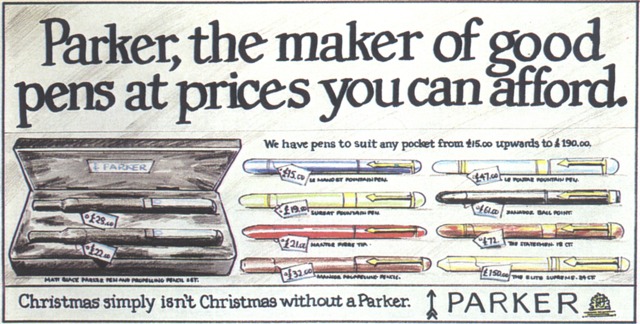
“The advert doesn’t make any mention of price. The pen you’ve chosen is quite expensive, so I was wondering if the ad could reflect the fact that Parker make a range of pens. You know, to suit every budget. We don’t want people to think we only make pricey pens!

“Also, and this is probably my mistake, I neglected to mention the matching presentation case the Parker 25 set actually comes in. And the guys in Brand went ape about the lack of a logo! Can you add the logo, and our Royal Warrant?

“Oh, and we’re in October now. People will be thinking about Christmas. Could you just add a nudge in that direction? Thanks”

“No problem,” says the account director.

“Brilliant! You guys rock. And that’s so true, about Christmas and Parker. Well done.

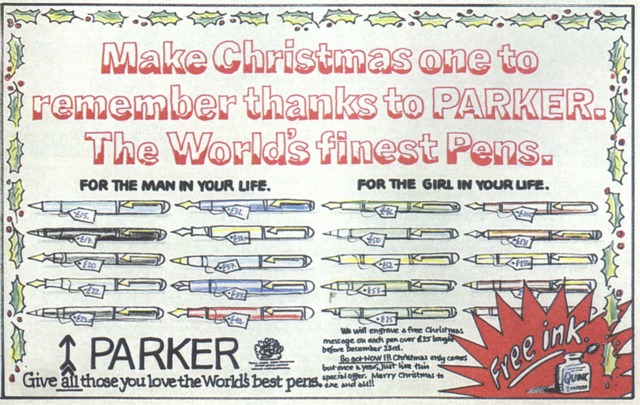
“You know, I was wondering if we could perhaps capitalise on that whole Christmas giving thing? I only ask because Parker offers an engraving service. That would be such a neat idea at this time of year. Plus I went on this advertising course where they kept going on about how the ‘offer is king’. So let’s just push this engraving idea, shall we?

“Otherwise it’s fine. Although we could perhaps big up Parker a bit. They don’t throw out these royal warrants willy-nilly, you know. We shouldn’t undersell ourselves.”

“Of course not,” says the account man. “I’ll see what the studio boys can rustle up.”

“Perfect. Looks like you’ve got everything in there.”

*reads for several minutes*

“Good. Very good. Although…”

“Yes?”

“Well, I showed the previous ad to Mrs Client, and she pointed out that it didn’t really shout ‘Christmas’ enough. Could you just make this one a tad more seasonal, do you think? Then we’re just about there, I reckon.

“Oh, and following on from that ‘the offer is always king’ thing I was telling you about, I had a bit of a brainwave about how we could drive sales by offering another of our products at the same time. It’s all about driving sales at the end of the day, isn’t it?”

“Ha ha ha, of course it is. I’ll ask the studio…”

“And the pens look a bit all over the place. It’s not immediately apparent who they’re aimed at. Could you group them according to whether they’re male or female pens?”

“A fantastic suggestion! I’m on the case.”

“We’re getting there. We’re certainly getting there.”

“That’s great news. I’ll…”

“Although, looking at it, there is rather a lot to take in, isn’t there?”

“Eh?”

“For a poster. Aren’t they supposed to have a maximum of eight words or something? That’s what you told me, I distinctly remember. You’re ignoring your own advice!”

“But…”

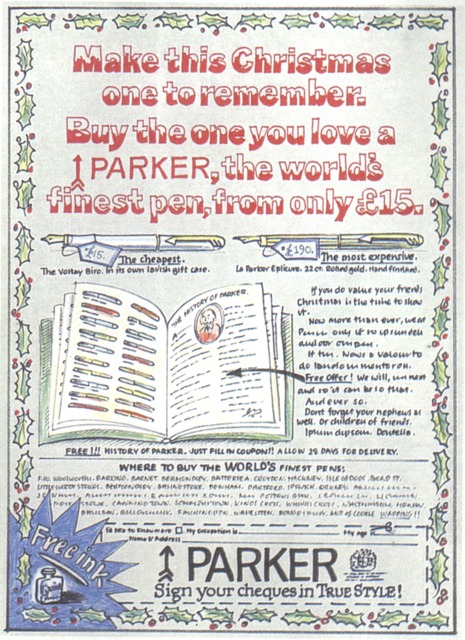
“Don’t worry. I have a solution. Instead of a poster, make it a press ad. That way you can get in a few more sales points. And a list of dealers. I know! Duh! Let’s make it a direct response ad and sell pens off the page! You know, I think we’re going to end up with something really quite different.”

“Yes, I think you might be right.”

“Brilliant! Anyway, must dash. I’ve heard a rumour that our share price is slipping…”

About this article

I found this piece in a very old edition of Creative Review. Although when I found it, it was called ‘the latest edition of Creative Review’.

I kept the magazine because I thought the piece was a funny and telling demonstration of many truths. How ideas are precious things, how the desire to ‘improve’ an idea is part of many people’s make-up, and how a willingness to please (or appease) a client can result in poorer and less effective work.

I lent the magazine to a creative director who thought it would be good for a talk he was delivering on the subject, and that was the last I saw of it. However, he had kept the visual elements of the piece, and these he kindly emailed to me. Unfortunately I don’t remember the author of the text that originally accompanied the visuals – I think it might have been the ex-CD of CDP, John O’Donnell. I hope my words have maintained the spirit and, hopefully, some of the wit of the original.

Resources

A (relatively recent) history of the Parker Pen Co, Wikipedia’s entry on Collett Dickenson Pearce, and some of their ads

Text © Kevin Mills 2013

14 Comments

Filed under Ill-informed advertising observations